Total Pageviews

Search This Blog

Sunday, March 8, 2020

One Step Closer to Rolica

This week I was able to finish work on another line Infantry Regiment for the British forces under Wellington, the 1/50th Foot, West Kent.  I took this opportunity to photograph the 9th British Light Dragoons that I completed last month as well.  Both of these units were originally painted by Dick Tennant, so my work was really just a touch-up.  I also finished adding 12 additional figures to the French 17th de ligne (my own work), to bring them up to battle strength given Dick Tennant's different organizational structure.
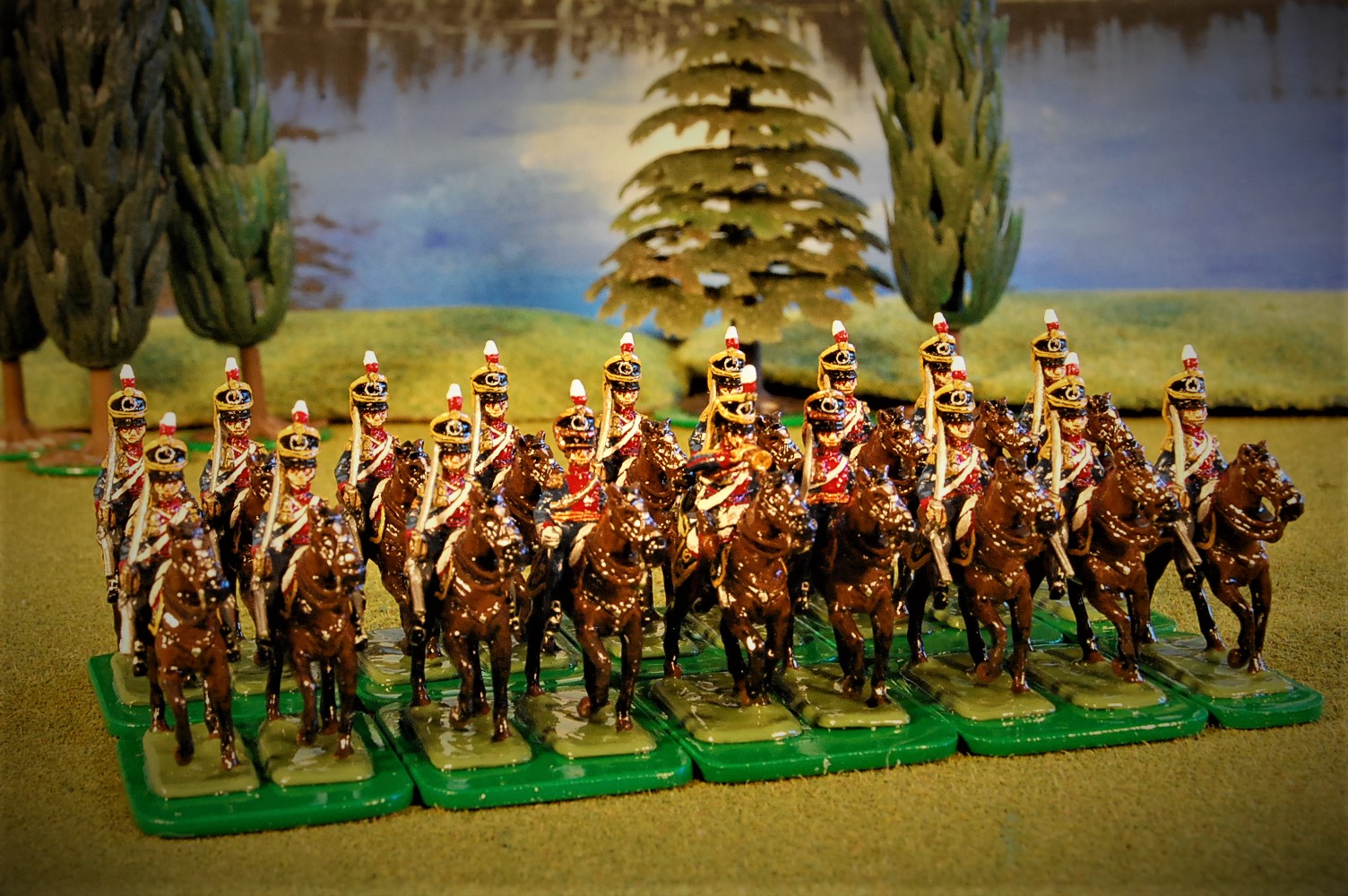
 

 British 9th Light Dragoons


 Every time I look at these I find more detail elements painted by Mr. Tennant.


The horses benefited from a dilute black ink wash for a bit of shading and to help with definition in the detail work.


  The painting on the saddle cloth is particularly nice.


 The 1/50th West Kent British Regiment of Foot is a 36 figure battalion, with three figures representing the light and grenadier companies on either flank of the unit.


 Apart from a little exposed brass, the flags of the 50th survived the journey across the Atlantic quite well.  The reason some did not fare well I believe is that some of the metal flags were made with a very thin foil, which did not travel well, whereas these were made from brass sheeting.


 Mr. Tennant has an incredible eye for detail, all the way to the color of the flag holders that distinguish a first battalion from the second battalion of the regiment.


 While initially I thought these had escaped relatively unscathed, as I began painting individual figures it became clear that there was a good deal of chipped paint on exposed areas.  Easy to repair, but it does require a meticulous treatment of each figure; plumes elbows and ankles are the usual subjects for chipped paint, but with these I also decided to highlight some of the white paint, as it had yellowed over time.


 The Colonel of the 50th (I think).  Originally designated a brigadier, so I need to do a bit of research and ascertain whether this figure can be demoted.  If not there is nothing that says the 50th can't be led into battle by their brigade commander.


 The newly expanded 17th French line infantry.  If you look closely you can see where twelve figures have their heads angled as if looking to the right.  I thought these were all the same pose and didn't notice the turn of the head until I was gluing them on their stands.


 I do love the bigger battalions!


 Below is an element I just finished for De Bellis Napoleonicus (DBN).  This is a very different approach to wargaming than the old school figures and rules for the collection above.  In DBN each stand represents roughly 1200 men.  The two figure stand below is meant to represent an under strength Cavalry brigade. 


 The figures are plastic 28mm French Hussars sculpted by the Perrys.


 The matt finish is easier to photograph, so I feel like the color is a little truer on these.  The high gloss of the old school look is so reflective it is trickier to photograph well, and I must admit to struggling with it.  I think I will see if I can try a diffuser next time to cut down on reflections.


 I am embarrassed to say how long these have been sitting on my desk unfinished.  I am going to try and keep plugging away and do a stand at a time with the eventual goal of being able to game Waterloo.  Currently I have over eighty stands done, but not all are usable for Waterloo, so I still have my work cut out for me.


 I was particularly pleased with the way the undulating terrain turned out.  The contour of the terrain was accomplished by gluing a block of blue insulation foam to the stand, and then cutting with a hot wire tool to shape it.

Hope you have enjoyed seeing these pictures.  If you enjoy my blog please leave a comment and follow my posts.  All the best,

David

Monday, February 3, 2020

The British are Coming! 150 years of the British Army in One Post!


At long last the British are progressing toward the end goal of recreating the battle of Rolica from the Peninsula War in 1808.  This was one of the few battles in which the British outnumbered the French during the Napoleonic Wars.  The French, however, were well situated on a steep hillside, protected by steep gullies on either side and a road to their rear for a retreat if needed.  The British sent out flanking forces to cut this line of retreat and advanced up the steep slope...


First up is the 71st Highland Light Infantry.  These hardy fellows survived their journey across the Atlantic very well, greatly simplifying my job in terms of getting them ready for the wargames table.  A little shading and highlighting was all that was required.  Thank goodness for Mr. Tennant who was the original painter and took on the distinctive highland checkerboard pattern around the bottom of the shako.


They are ably led by Colonel Francis Dundas, who urges them forward.


Now he's just showing off his equestrian skills.


No Highland regiment would be complete without a piper!  If anyone has a highland drummer and two ensigns with standards I could get these gents ready for the parade ground - hint, hint...


I don't think I have ever posted a picture of the bottom of the stands, but all units are identified on the bottom to aid in keeping them together, and to remind me what they are!


This is a delightful little vignette that Dick Tennant put together of a Brigadier and an officer from the 60th American rifles.  The horse was a little worse for wear after his journey and was a bit wobbly legged and off kilter, but easy enough to straighten out and stand upright again.  Just a little shading and a few highlights to bring out the richness of the colors was all that was needed for the humans. 


The basing on these still needs its final coat of varnish, but I thought they were close enough to being done to stand for their picture.


The 60th emerges from the woods...


and then remembers they are skirmishers and ducks back under the trees for cover.


The two poses were clearly painted at different times and I had to do a bit of detail work to get them consistent, but I am very pleased with the end result.


The lace on the trousers is all Dick Tennant's work.  Really an amazing hand for detail he has.

And now much much later...

Fast forwarding 150 years, another famous British army, the 8th, claimed fame in the desserts of North Africa combating Germany's vaunted Afrika Corps under the Leadership of Erwin Rommel.  I came upon this diversion from my normal Napoleonic modeling when a colleague brought an ancient Airfix model of a Grant/Lee tank to one of our monthly game days.  I remembered trying to build this kit as a youth and the frustration it evoked.  I decided to try it again as an adult, and must say the frustration was still there.  This was not one of Airfix Model's better efforts; parts were malformed and/or ill-fitting, but epoxy putty can cover a myriad of sins. 


Does anyone else remember when they came in bags instead of boxes?


I couldn't model the Grant without some infantry support, so I attempted to paint some of the Airfix soft plastic figures from the same era.  I can't say this was fun, as removing the flash from these soft plastic figures is a chore, and I must admit I was not particularly good at it.  The final result was more than passable though.  
 
Enough stage setting.  Without further ado, I present the M3 Grant and an infantry squad.


The soft plastic of the infantry was primed with a fusion primer especially formulated to bond with plastics.  Once painted they were sealed with acrylic washes, and a spray of Dullcote.  Flexible parts such as rifles, bayonets and ankles were then coated with white glue.  When dry, one final spray of Dullcote was added.


The infantry are all mounted on metal washers that are then painted and dredged through some sand for texture.


I'm not entirely convinced that the tracks of an M3 were loose enough that they would have sagged between the rollers, but the provided rubber tracks of the model were far too long and this was how I was able to get them snug up against the driver wheels.


Saturday, January 11, 2020

French Pontoon Train and the 39thin L'orde Mixte

Before embarking on a description of my project for the new year, I think it only appropriate to show some finished pictures of the French pontoon train, masterfully painted by Richard Tennant and lovingly restored by myself.  Of course there is no reason to build a pontoon bridge if you don't have troops to cross it, so I am pleased to add the second battalion of the 39th Line Infantry Regiment ready for action!


 Many thanks to my daughter who spent four hours watching Bob Ross and recreating one of his landscapes on canvas.  It amazes me what she was able to do in that time!  Equally impressive is how well it works as a backdrop for the miniatures!


 The pontoon train consists of a 3 wagons; one for tools and hardware, and the others for the lumber and the pontoons themselves.


 As usual, Dick painted a company in march formation and one deployed for construction.


I always think my highlighting looks a little heavy handed in these pictures, but at actual size it reads very well and appears much more subtle.


Ever since seeing the description of the L'orde Mixte formation in the Airfix guide I have longed to recreate it in miniature.  With the 39th Regiment complete I can finally do so.


 Here we have the regimental Colonel, Louis Thevenet, and his subordinate, the Chef de Battalion of the 2nd battalion.  These are lovely figures from Franznap that I ordered to fill out the leadership of the regiment.  I was very pleased that my painting of these seems up to the standards set by Mr. Tennant.


 Here the 39th descends from the foothills of the Pyrenees Mountains ready to do battle!


General de Brigade Chemina, as yet unpainted, has climbed a small hill to get a better view of his magnificent troops.


 Suddenly the way back machine ala Wellington Man, gives the troops the appearance of having stepped out of the pages of Bruce Quarie's Airfix Guide to Napoleonic Wargaming, which is only too appropriate since these are the very same figures that were featured in that guide more than 40 years ago!


 And back to the technicolor present.


 I don't think I have shown off the 13th Cuirassiers since they replaced the tattered blue of their uniform coats with locally obtained cloth of Spanish brown.


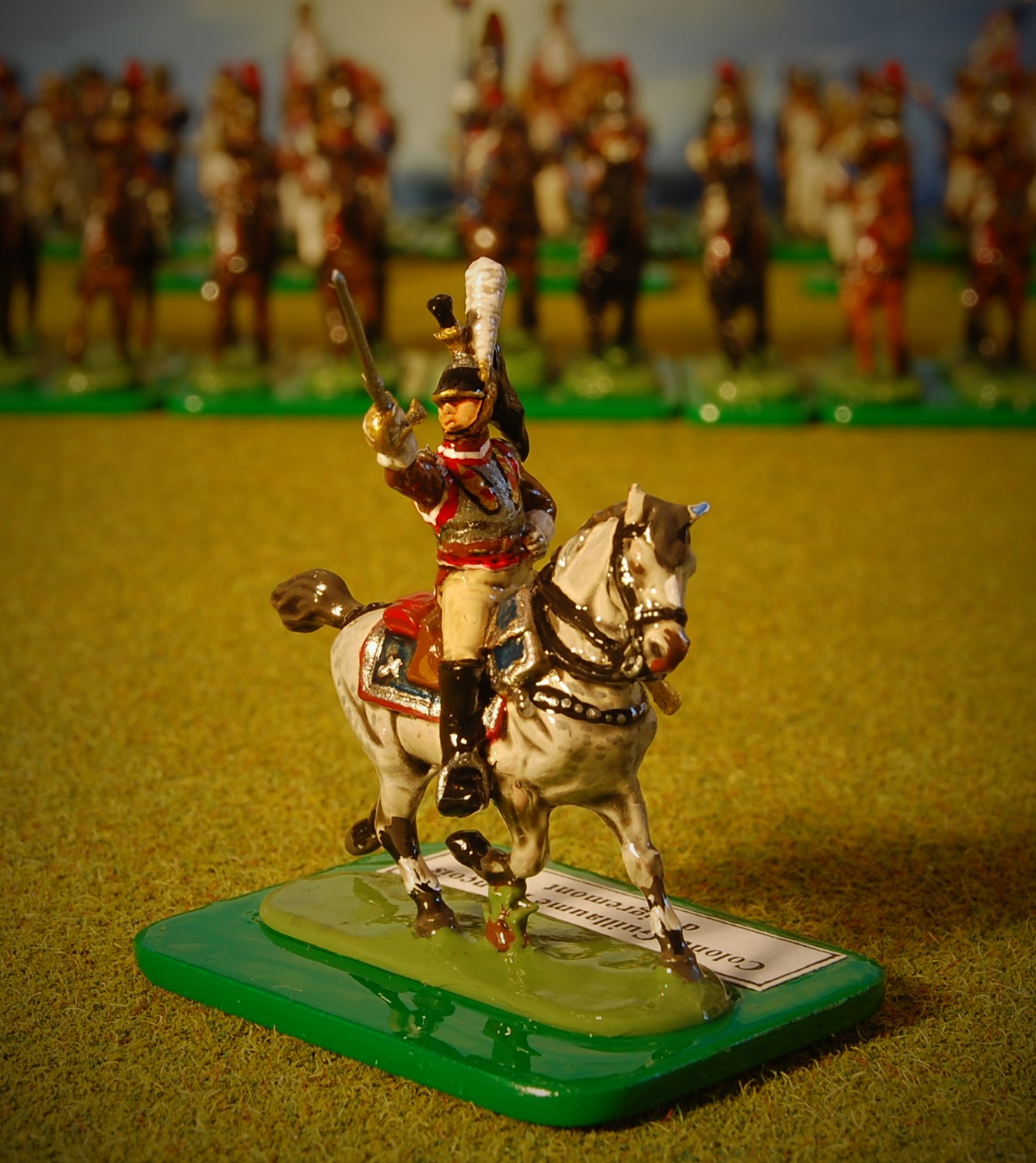
 Colonel Guillaume Francois d'Aigremont leads his troops in review.


 It is hard enough to find troopers in these vintage figure lines, not to mention Colonels.  For Colonel d'Aigremont, I have actually used a figure from the the plastic set by Zvezda.  While I much prefer the feel of metal figures, I was quite pleased wit the quality of the sculpting, and of the casting of the Zvezda figures.  I am actually considering incorporating some of their Old Guard Grenadier figures into the that illustrious battalion when it hits the painting table.


You have to love the animated pose of the figure!


And the nicely proportioned sword!

Next post will feature some British at long last, as the French have all of the necessary troops ready for the battle of Rolica.  I will be substituting Bavarians for the Swiss and will of course feature different battalions than those actually present, but the basic troop types are now well represented and ready for combat.  Below is the OOB taken from the Napoleon series:


The French force consisted of about 4,350 men:
Commander: General Delaborde
70th Ligne Regiment (2 Battalions)

1st Provisional Light Infantry:
1 battalion from the 2nd Légère Regiment 1 battalion from the 4th Légère Regiment
4th Swiss Regiment (1 Battalion)

26th Chasseurs (250 men)

1 Company of Artillery (5 guns)
Up Next, the 71st Highland Light Infantry will be going through its paces while I also work to bring the 17th Ligne and Fuslier-Chasseurs up to strength given the gigantic battalions Mr. Tennant created!