Total Pageviews

Search This Blog

Showing posts with label Legion du Midi. Show all posts

Sunday, January 2, 2022

Légion du Midi

Légion du Midi

In 1804 the Piedmontese Legion was renamed Legion du Midi. The legion took part in the following battles: Beja (1808), Corogne (1809), Busaco (1810), and Fuentes-d’Onoro (1811).  From: Napoleon's Foreign Infantry - https://www.napolun.com/mirror/napoleonistyka.atspace.com/infantry_Napoleon_3.htm
 
 The legion was made of discharged Piedmontese veterans, who probably were occasionally drunk and disorderly. It went into Spain, where it served well enough but gradually fell off in strength to a single battalion. - John Elting


Uniforms of the Légion du Midi

 In researching the uniforms for the Légion du Midi, I was fortunate to have Philip Haythornthwaite in my corner, who kindly sent me an extensive description of the likely uniform worn in 1811 as a response to a question I had regarding the shakos and whether cords were worn.
 
Here is the response from Mr. Haythornthwaite:


Der Kriegspieler Old Guard Grenadiers serving as Grenadiers of the Légion du Midi - note the extra card under the base to give the rather thin bases a bit more heft.


From Napoleonic Uniforms - John R Elting, with illustrations by Herbert Knotel


The Voltigeurs have a similarly altered base, but the most evident change is the removal of cords from the shako, and the replacement of the eagle with the lozenge shaped regimental badge.


A Franznap French line Colonel serving as General de Brigade Jean-Pierre Maransin, who commanded the legion from 1807 to 1811.  From Wikipedia: Maransin participated in Andoche Junot's invasion of Portugal and was stationed in the southern province of Algarve when the revolt against French occupation broke out. When his bedridden commanding officer Antoine Maurin was captured by the Portuguese, Maransin gathered up the troops in the province. These 1,200 men included the Legion du Midi and one battalion of the 26th Line Infantry Regiment. He successfully withdrew to Lisbon via Mértola and Beja.


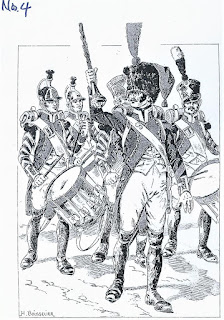
The officers, drummer and eagle bearer are all Der Kriegspieler with minor modifications, such as the lozenge shaped regimental badge on the drummer's shako along with removal of the cords.  While the Boisselier print emphasizes the helmet style of head wear for drummers, you can also see the more traditional shako peeking out from behind the Drum Major's colpack.


The Chasseurs of the Legion have all had their shako cords removed, regimental plate added from a square of card stock, as well as epaulets and 'lentille' shaped pompom sculpted from epoxy putty.  There is no escaping the fact that DK figures are just thin and weedy however.  Forage was difficult to obtain in Spain for the French, so who knows, maybe the emaciated look of the soldiers is quite accurate.


While this drawing of Boisselier features a Voltigeur, it can be seen that the Chasseur in the background also carries the sabre-briquet, which had to be added to the Der Kriegspieler miniatures at the last minute, as I had missed that detail!


The Legion ready to receive it's paint.


Primed plus!


Almost there...

Le Légion du Midi

Five months from start to finish!
 
Jean Pierre Maransin was promoted Colonel of the Legion in 1807, but must have been well connected, as he was promoted again to General de Brigade in 1808, while retaining command of the Legion.

He is pictured here in the uniform of Colonel.

The natural imperfections of the casting process served well to dapple the rump of his horse.

I really think the Franznap miniatures are the best sculpted figures on the market.

The Legion to the fore!

The eagle is from a set of standards cast by Hagen in Germany, with the wire pole replacing the original cast on thick flag and staff of the Der Kriegspieler figure.

A GMB designs 15mm flag slightly modified was used as the standard, which I have embellished with gold tassels.

Note the swords on the Chasseurs front left.  Originally the cross belts ended in nothing on this side, which was a bit odd.  When I realized the Chasseurs were also equipped with sabre-briquets, I quickly attacked some plastic grenadiers and stole their swords for the role here.

I love the uniforms of the Voltigeurs and Grenadiers especially.

So many back pack and greatcoat straps!

The Legion du Midi was brigaded with the Legion Hanovrienne, which was the inspiration for creating this rather obscure battalion.  Dick Tennant did the original work on the Legion Hanovrienne, so it seemed only right that I finish what he started and paint their companion battalion.

Next up will be something much simpler I hope...


Sunday, November 7, 2021

November 2021 - Works in Progress

 I have a fair number of units under way for my old school Napoleonics collection, so though none are finished yet, I thought it would be interesting to show some works in progress.  This should give an idea of my process, an idea that I have shamelessly stolen from Aly over at Aly's Toy Soldiers.

The Legion du Midi is well underway with all of the base coats essentially done.  The devil is in the details as they say and these fellows will be no exception; lots of fiddly work still to do.  The prep work on these was challenging as well.  All of the shako cords were removed, a carrot shaped pompom added, and the shako plate of an eagle removed to be replaced by a teeny tiny diamond cut from cardstock.  The rank and file as well as the command on foot are all Der Kriegspieler miniatures, while the mounted Colonel is an exquisite modern figure made by Franznap.

Also just now getting underway are two line battalions of French infantry, painted by Richard Tennant.  These battalions were featured in the Airfix guide to Napoleonic Wargaming by Bruce Quarrie.  Mr. Tennant and Mr. Featherstone contributed a good many of the pictures that were used in that guide.  I still can't believe I ended up owning a collection that was so vital to my early interest in the hobby.

Here's how they appeared in the Airfix guide, though of course in black and white.  Mr. Tennant still had copies of the original images, which he kindly shared with me after I realized his figures had been featured in Napoleonic Wargaming.  I hope to have them spruced back up to their original glory soon.

Unfortunately the trans-Atlantic crossing was pretty rough on the collection and there were a few casualties and a lot of chipped paint.  The metal is so soft in these early Alberken figures, that drilling out the ankles to put in support posts was a very challenging process.

But worth it in the end!

A little bit of green stuff and he will be good as new.

The Battalion flag for the second battalion was in pretty rough shape so I decided it would be best to replace it.  Though I try to stick with the original paint scheme as much as possible, I think I will likely paint over the inked in flag holder, as the way it is presented just doesn't seem particularly practical.

The first battalion eagle and flag are actually still in pretty good shape so I will likely keep them, but may add the complete baldric, rather than just have it painted on as it is presently.

My current conundrum, which I would love feedback on is two-fold: 1) Should I pare down the Alberkan grenadier, sapper, and voltigeur stands so that they match the Hinton Hunt fusilier stands which are the majority of the battalion?  2) I swear I have seen this before, probably in the Funken uniform guides, but were there really white, over the knee gaiters, with black boots?  I suspect I will keep this as it hearkens back to the early days of our hobby, but was this really a thing?

My buddy Rob has been harassing me to get on the stick and get the first of the Vimiero scenarios ready, but sometimes you have to take a break and just enjoy life when the occasion presents itself.  Not long ago we got the chance to enjoy my wife's fall break in nearby Chattanooga on the banks of the Tennessee River.  Sometimes the little metal guys have to take the back seat!


I've also been busy harvesting the last of the garden veggies.  On the stove is a mash of fermented and pulverized Jalapeno, Poblano, and Anaheim peppers.  Not too spicy but oh so flavorful!

Alright, back to business.  Along with all the infantry I have been prepping three squadrons of Imperial Guard Chasseurs-a-Cheval, and the attached squadron of Mameluks.  For these I am using Minifig s-series as well as early minifigs, which are in this case quite similar.

I have worked to give the figure pose a little more animation, as well as shorten the sword to be more in line with the Der Kriegspieler Chasseurs-a-Cheval.  Size-wise the two figure brands match remarkably well.

The Chasseurs-a Cheval of the Imperial Guard were known to have a Mameluk kettledrummer, so I converted a trooper into a convincing looking drummer.  I was also very fortunate to find a bugler for the Mameluk squadron.

The kettle drums themselves were actually cut from a 15mm Essex camel drummer from their Ottoman range, to which I used epoxy putty to model the drum cover and fringe.  I also stole his drumsticks.

Here is the command group for the Chasseurs-a-Cheval of the Imperial Guard, all made from converted troopers.

The bugle was donated by a spare Mameluk who had no need of it, and the eagle is actually available as an accessory pack from Hagen.  The cord attached to the bugle is actually from Richard Tennant, who sent a few of his modeling supplies along with the collection.

Here is a shot of the command figures in process.  In the background you can just make out the Legion du Midi before receiving their brown jackets.

Lastly, as if all this were not enough, I wanted to give a quick shout out to Wellington Man who let me hang onto these beautiful Hinton Hunt castings of the Princess Dragoons from a figure lot he found here in the US.  Many thanks WM.  They are already cleaned up and stripped of the old paint.  I understand know why you are always eager to get the Hinton Hunt castings over the Der Kriegspielers.  These really are magnificent little figures.